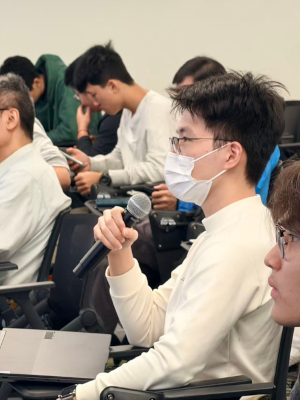
On 11 November 2026, the Department of Electrical Engineering and the Department of Computer Science in City University of Hong Kong (CityUHK), in collaboration with Huawei, hosted the "CityUHK × Huawei Atlas Technology Salon" at the Inter-Continental Plaza (ICP) in Tsim Sha Tsui East, Hong Kong. The event attracted over 100 participants, bringing together individuals interested in artificial intelligence, high-performance computing, and emerging AI technologies.
The event commenced with opening remarks by Prof. Ray Cheung, Associate Provost (Digital Learning) and Professor in the Department of Electrical Engineering at CityUHK, who welcomed the participants and introduced the research activities of the CALAS Research Group. The event also featured a brief introduction to OpenCERV (CityUHK-EE RISC-V Open Community), a community initiative supported by CityUHK EE and CALAS that aims to foster collaboration and knowledge exchange in RISC-V, digital IC design, computer architecture, and related technologies.
The technology salon focused on advanced AI computing technologies, providing participants with insights into large language model (LLM) training, inference deployment, and compiler optimization within the Huawei Atlas AI computing ecosystem. Through a series of technical presentations and practical demonstrations, the salon explored tools and techniques for improving AI computing performance and efficiency.
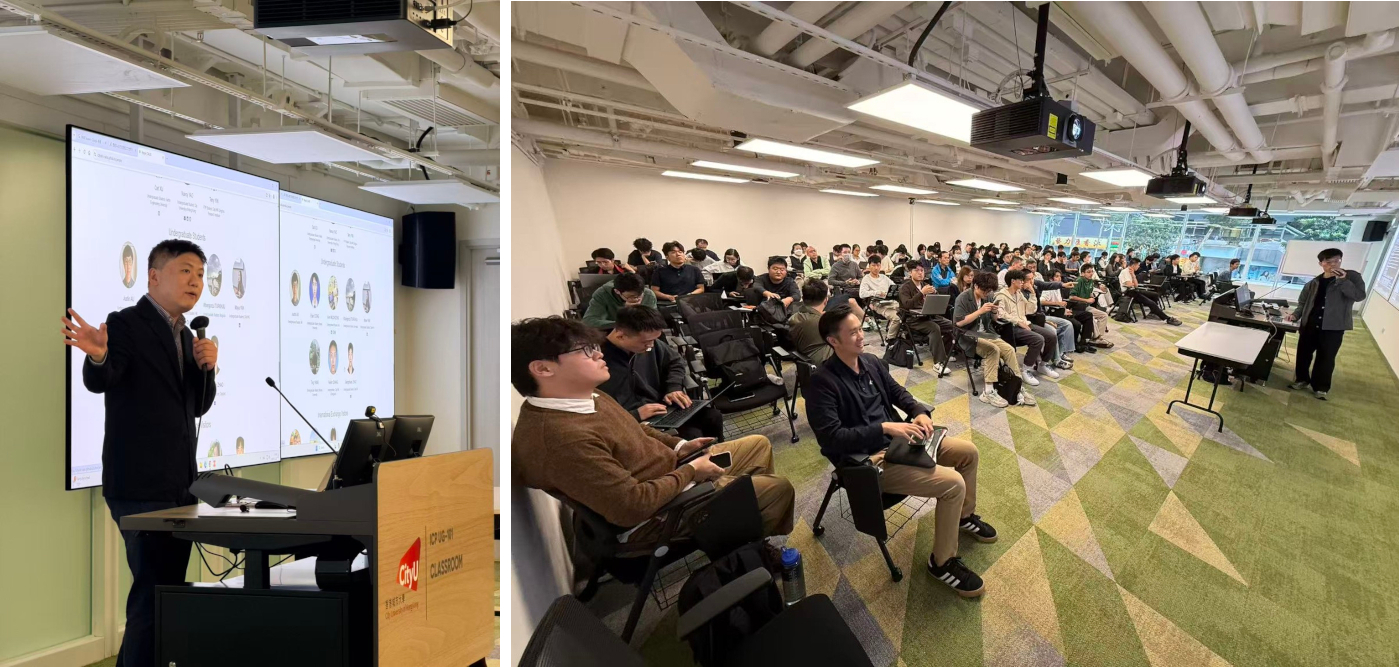
The programme featured technical sessions covering end-to-end LLM training using MindSpore and the MindSpeed training suite, reinforcement learning workflows with verl, and model inference deployment and optimization using vLLM-Atlas and SGLang. The sessions also introduced distributed training strategies, model quantization, and inference acceleration techniques, highlighting practical approaches to improving computational efficiency and hardware resource utilization.
Another key focus was TileLang, a domain-specific programming language for high-performance AI computing. The sessions introduced its programming model, compiler optimization techniques, automated performance exploration, and practical kernel development. Participants gained insights into how TileLang can simplify the development of optimized AI kernels while enabling efficient execution on AI accelerators.
The event featured five speakers, including Zhang Shengming and Zhang Yuzhi, Senior TileLang Architecture Engineers; Wu Xinyi, Huawei Ascend Computing Engineer; Miao Tingwei, Ascend Product Manager; and Vigor Fung, Sales Director. The speakers shared their technical expertise and industry perspectives on AI computing technologies and their practical applications.
The technology salon provided participants with valuable exposure to emerging AI computing frameworks, development tools, and optimization techniques. It also served as a platform for knowledge exchange between academia and industry, fostering connections and exploring opportunities for future collaboration in AI computing and related research areas.